
Technical article · Desalination
An alternative for the blind spot of seawater intake
Chlorine, copper, biocides. Engineers know the list, and they know that each option carries its own environmental cost. At the same time, operators in the sector are pushing their sustainability commitments further than ever: zero pollution in discharges, ESG policies built into every project. Intake is precisely where that commitment is tested: the first place seawater enters the plant, and also the first place the chemicals that treat it enter.
The trade-off the industry accepts today
Continuous chlorination is cheap but only moderately effective against hard shells, and its by-products fall under the priority substances regime of the Water Framework Directive. Copper kills bacteria within hours, but it is a recognised coastal pollutant, bioaccumulative, and hard to justify in a sustainability report with a zero-pollution target. When neither is enough, mechanical cleaning remains: reactive, and with waste that is usually returned to the sea.
A physical route to the same problem
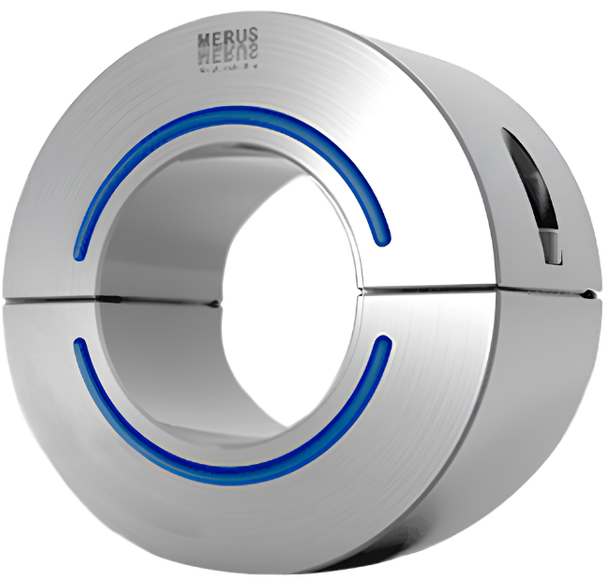
Merus Chain is a modular chain of stainless steel blocks filled with factory-treated aluminium, installed externally on the submarine intake pipe. Installation requires no pipe cutting, no filters and no electricity: the whole process is carried out from the outside, without stopping operation. Merus technology emits low-intensity active oscillations. These pass through the pipe wall and travel in the direction of flow, very fast and very far. As a result, the solubility of all soluble substances in the liquid increases.
In this way there is far less fouling: scale, corrosion and biofouling are drastically reduced inside the pipe.
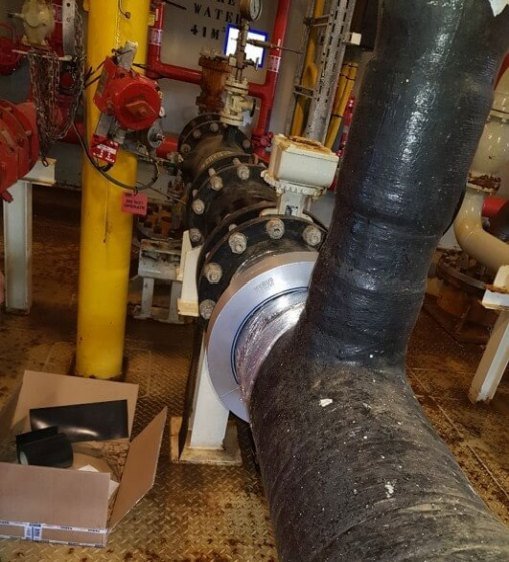
Intake riser, offshore platform, Qatar
An offshore platform in Qatar faced severe biofouling in the intake riser, progressively blocking the flow and disabling the heat exchangers.
| Parameter | Before | After |
|---|---|---|
| Pipe | Progressive blockage | Free cross-section |
| Maintenance interval | 6 months | 12 months (extended 2×) |
| Cleaning | Mechanical | Physical |
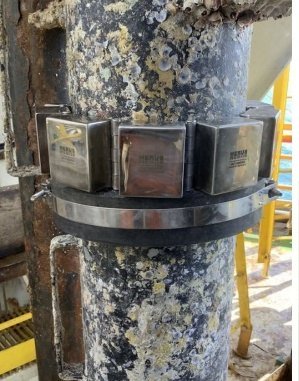
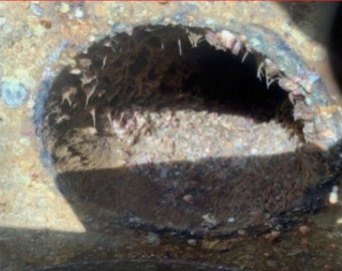
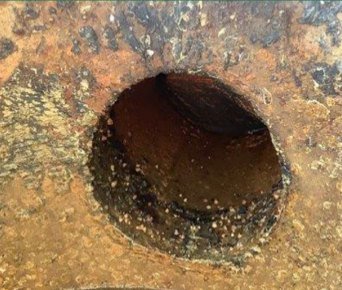
Intake riser in Qatar. Source: Merus GmbH.
Intake line, patrol vessel, Netherlands
The same technology family, in Merus Ring format, also protects accessible intake lines inside the hull. On the patrol vessel RWS 78, mussels, barnacles and biofilm were colonising the entire cross-section of the seawater intake line. Without treatment, complete blockage occurs in roughly 12 months.
| Parameter | Before | After |
|---|---|---|
| Pipe | Almost total blockage | Practically free cross-section |
| Maintenance interval | 12 months | 36 months (extended 3×) |
| Cleaning | Mechanical | Physical |
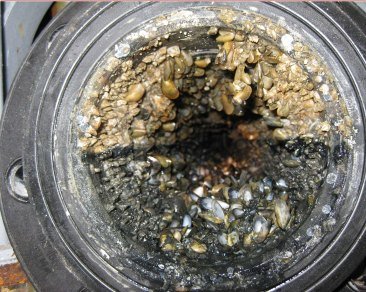
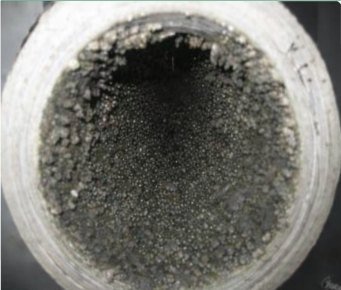
Intake line, patrol vessel RWS 78. Source: Merus GmbH.
Why it matters in the Iberian context
Spain has more than 700 desalination plants, most of them with direct seawater intake. A physical treatment at that point does not replace the existing treatment programme, but it reduces the load reaching it: fewer organisms entering, less biofouling on pre-filters and membranes, lower dependence on chemical dosing at the first point of entry.
The technology has proven effective over several years in other segments, in applications with boundary conditions similar to those of a desalination plant. AEDyR members can run pilot projects with measurement protocols agreed before installation: membrane differential pressure, SDI (Silt Density Index), CIP (Clean-in-Place) intervals and antifouling consumption per m³ produced, to verify on site the real extent of the benefits.
Merus Iberia has been an AEDyR member since 2026. We propose evaluating a pilot at the intake point with a measurement protocol agreed before installation: dynamic water level, differential pressure, screen cleaning frequency and biocide consumption.
The figure below shows an example of a hypothetical installation:
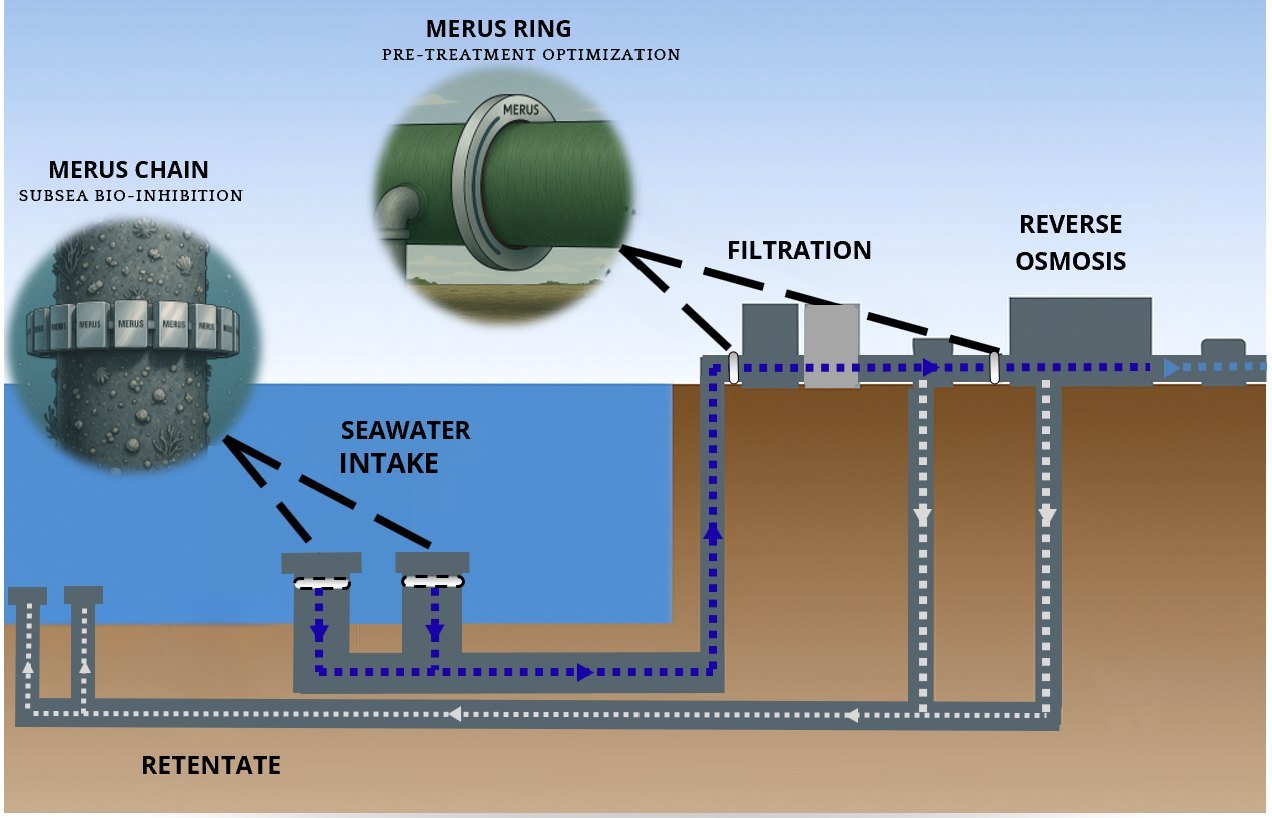
Intake pilot
A 6-month pilot at the intake point
Valid for your intake point or for the most scale-affected system in your plant. Measurement protocol agreed before installation: dynamic water level, differential pressure, screen cleaning frequency and biocide consumption.